
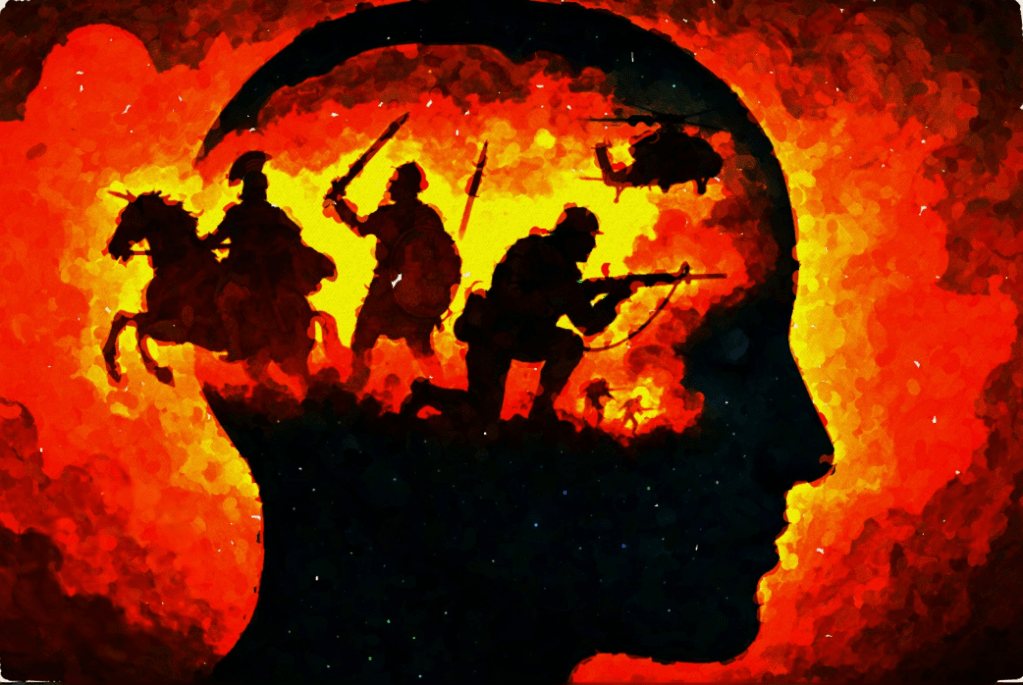

Human history, when viewed through the lens of its recorded milestones, emerges as a tapestry woven with the threads of war, conflict and collective struggle, all dyed in the blood of billions. Civilisation, that grand edifice erected through ingenuity and toil, has ever been shadowed by destruction. It is in the paradox of creation and annihilation, of ascendance and collapse, that we discern a deeper force at work—a force beyond the agency of individual actors or the superficial determinism of economics and politics.
From the early tribal skirmishes of prehistory to the devastating global wars of the 20th century, narratives of violence and conquest dominate our collective memory. This historical fixation fosters a pervasive belief: war is humanity’s natural state, an inescapable condition that defines progress, identity, and survival. This view is reinforced by the centrality of war in cultural narratives, where it is often portrayed as the ultimate crucible of heroism and transformation.
Beyond the historical and sociopolitical dimensions of war, however, lie profound psychological forces that shape its recurrence. Carl Gustav Jung’s concept of the collective unconscious provides a lens through which to explore the archetypal drives underlying human conflict. Similarly, Oswald Spengler’s cultural-historical theory in The Decline of the West offers insight into how civilisations cyclically rise, flourish, and decay, often with war as both symptom and cause. Together, Jung and Spengler provide a dual framework—psychological and historical—for understanding why humanity appears trapped in recurring cycles of violence.
Living in an age where the spectre of escalating conflict in Vietnam haunts our discourse and the threat of mass annihilation is constantly within our periphery, it behoves us to interrogate the very essence of human proclivity toward self-destruction. Is this propensity an aberration, a defect to be corrected through rational activism, or is it a reflection of immutable psychic forces? This essay contends that humanity’s historical trajectory, interpreted through Spenglerian decline and Jungian depth psychology, reveals a collective unconscious irresistibly drawn toward annihilation as both an expression of enantiodromia and an unconscious desire for reintegration with the primordial whole.
Spenglerian Cycles and the Inevitability of Decline
In ‘The Decline of the West’, Oswald Spengler’s theory posits that civilisations, like living organisms, experience a natural lifecycle of birth, growth, maturity, and eventual decline.1 He distinguishes between Kultur (culture) and Zivilisation (civilisation): the former representing the creative, spiritual, and vital phase of a society, and the latter marking its descent into materialism and stagnation.
For example, Spengler interprets the transition of ancient Greece from its cultural phase—defined by the profound philosophical contributions of Socrates, Plato, and Aristotle—to its civilisational phase during the Hellenistic era, marked by empire-building and military expansion. Similarly, the Punic Wars between Rome and Carthage were pivotal in establishing Roman dominance, but they also marked the beginning of Rome’s transition from a republic grounded in civic values to an imperial power defined by autocracy.
According to Spengler, war often emerges as a symptom of this transition from culture to civilisation. As societies mature and their spiritual vitality wanes, they increasingly resort to conflict as a means of maintaining or asserting dominance in a competitive, materialistic world. As such, Spengler’s vision of history is neither linear nor progressive but cyclical, akin to the rhythms of nature that propels them toward expansion and ultimate exhaustion. This inexorable trajectory mirrors the cycles of life itself: vitality is followed by senescence, and decadence preludes death.
Spengler’s deterministic outlook emphasises that war accelerates the decay of civilisations, even as it catalyses new forms of societal organisation. This dual role underscores the paradox of conflict: while it is often seen as a pathway to renewal, it also hastens the disintegration of cultural and spiritual vitality: the cultural vigour that birthed the Gothic cathedral and the scientific revolution has calcified into technocratic efficiency and sterile materialism. As Spengler observed, such a phase is marked by the atrophy of creative potential and the ascendancy of force as the predominant mode of resolving existential tensions. Herein lies the paradox: as civilisations mature and accumulate unprecedented technological and economic power, they simultaneously accelerate toward their dissolution. The weapons of mass destruction stockpiled in our era are not anomalies but logical extensions of a civilisation in its twilight.
Jung and the Collective Unconscious: The Depths of Enantiodromia
At the opposite end of our investigations, Carl Jung’s exploration of the collective unconscious illuminates the psychic undercurrents driving Spengler’s cyclical patterns. Jung identifies within the psyche an archetypal structure, shared across humanity, which governs not only individual behaviour but also collective phenomena.
Jung’s forewarnings during his 1930s seminars resonate with chilling clarity in our era. He perceived the accumulation of military might and ideological fervour not as the product of rational strategy but as symptoms of psychic imbalance. What is most alarming is Jung’s assertion that the collective unconscious can seek annihilation as a means of psychic catharsis. In his Seminar on Zarathustra, Jung warned that the build-up of armaments and the invention of weapons of mass destruction reflected the unconscious desire for a grand purgation.2 The notion of a “higher will” compelling humanity toward destruction is not a metaphysical abstraction but a psychological reality grounded in the dynamics of enantiodromia—the tendency of forces to transform into their opposites.3
When a civilisation tilts excessively toward a singular ideal—be it technological mastery, imperial expansion, or utopian progress—the collective unconscious demands equilibrium. War and destruction thus emerge not as aberrations but as the psyche’s violent corrective mechanisms.4
The Vietnam War’s burgeoning escalation exemplifies this dynamic. Despite widespread repudiation of armed conflict in principle, humanity remains ensnared by deeper compulsions. The collective unconscious, suffused with unresolved shadows, projects its darkness onto external enemies. Nations demonise one another, perpetuating cycles of violence as unconscious forces drive humanity inexorably toward annihilation.
War, in this context, becomes a collective ritual—a destructive but cathartic act through which societies attempt to resolve their inner tensions and restore a sense of cohesion. The psychological allure of war lies in its capacity to dissolve individual boundaries, uniting people under a shared purpose or identity. Yet, this unity is fleeting and illusory, as it often perpetuates the very divisions it seeks to overcome.
War as Collective Desire to Return to the Primordial
Beyond enantiodromia lies a more unsettling implication of Jung’s insights. The collective unconscious, according to Jung, is not merely a repository of archetypes but also a connection to the primordial origins of existence. Life, for all its apparent separateness, emerges from and ultimately returns to an undifferentiated oneness. Death is the dissolution of individuality into the greater whole, a process mirrored in the destructive impulses of war.5
When civilisations accumulate sufficient power to transform the earth itself—whether through industrial revolution or weaponry evolution—they unconsciously seek a return to the primordial. The annihilation of millions, horrific as it appears to the conscious mind, is a re-enactment of the death instinct on a collective scale.6 The machinery of war, from the trenches of Verdun to the jungles of Southeast Asia, operates as the shadow side of civilisation’s yearning for transcendence. In death, humanity’s separateness dissolves, achieving a grotesque unity in destruction.7
The Role of Memory and the Poison of Historical Consciousness
Historical memory compounds these psychic forces: our history is remembered through war and conflict, poisoning our collective outlook. Generations inherit not merely the factual record of past wars but also the psychic imprint of collective trauma. The glorification of martial valour, the narratives of triumph and defeat, and the perpetuation of grievances all serve to normalise violence as the default state of humanity.8
Yet history is not merely a chronicler; it is also a creator of psychic reality. The psychological impact of war extends far beyond those who experience it directly and the concept of transgenerational trauma illustrates how the unresolved grief, fear, and anger of one generation can shape the cultural identity of the next: in post-colonial societies like India and Pakistan, the legacy of partition violence continues to influence intercommunal relations, as memories of trauma are passed down through oral histories, literature, and education.
This phenomenon aligns with Jung’s insights into the collective unconscious, as the psychological wounds of war become embedded in cultural memory, perpetuating cycles of fear, mistrust, and retaliation. To view the human past through the lens of war is to perpetuate its inevitability. Spenglerian decline finds an apt metaphor here: the monuments of past conflicts, both physical and symbolic, are the mausoleums of creative vitality. As long as we venerate the martial past, we remain imprisoned by it, re-enacting its patterns on ever-grander scales.9
Toward an Integration of the Shadow
Jung’s admonition to integrate the shadow—to confront and assimilate the darker aspects of the psyche—offers the only viable path out of this cycle. Such integration, however, demands profound spiritual labour. It requires individuals and collectives to relinquish the comfort of moral dichotomies, wherein good and evil are externalised, and to acknowledge their own complicity in humanity’s destructive tendencies.10
This task is Herculean precisely because it is antithetical to the superficialities of modernity. A civilisation preoccupied with technological conquest and material accumulation has scant patience for introspection. Yet without such inner work, humanity remains at the mercy of unconscious forces, its professed desire for peace forever undermined by unacknowledged violence.11
A Reckoning with the Higher Will
In summation, the convergence of Spengler’s historical philosophy and Jung’s depth psychology illuminates the grim reality of our present condition. War and annihilation are not external calamities imposed upon humanity but intrinsic expressions of the collective psyche. The higher will Jung invokes is not divine; it is the implacable logic of enantiodromia and the death instinct, manifesting through the machinery of civilisation.12
To break this cycle demands nothing less than a re-evaluation of our very conception of humanity. Are we, as Jung suggests, willing to confront the darkness within? Or shall we continue to project it outward, condemning ourselves to perpetual repetition of history’s bloodiest chapters?13
As we stand on the precipice of an uncertain future, the lessons of Spengler and Jung resonate with urgent relevance. Civilisation’s Faustian bargain, its ascent toward mastery over nature, must be tempered by a recognition of the psychic forces it unleashes. Only by embracing the totality of our nature—light and shadow alike—can we hope to avert the annihilation that our collective unconscious so fervently courts.14
The task is monumental, for it requires nothing less than a collective awakening to the dynamics of the unconscious and the courage to reimagine civilisation itself. Whether we have the will to undertake such a transformation remains to be seen, but the stakes could not be higher. For as Spengler and Jung remind us, the alternative is not merely decline but annihilation—and perhaps, in some distant future, rebirth.
[1] Oswald Spengler, The Decline of the West, Vol. 1, trans. Charles Francis Atkinson (New York: Alfred A. Knopf, 1926).
[2] Carl Gustav Jung, Seminar on Zarathustra, unpublished lecture notes, 1934-1939.
[3] Carl Gustav Jung, The Archetypes and the Collective Unconscious, trans. R.F.C. Hull (Princeton: Princeton University Press, 1959), 221.
[4] Jung, Collected Works, Vol. 10, “Civilization in Transition” (Princeton: Princeton University Press, 1964), 47.
[5] Sigmund Freud, Beyond the Pleasure Principle, trans. James Strachey (London: Hogarth Press, 1922), 32–47.
[6] Friedrich Nietzsche, Thus Spoke Zarathustra, trans. Walter Kaufmann (New York: Viking Press, 1954), 101.
[7] Erich Neumann, The Origins and History of Consciousness, trans. Ralph Manheim (Princeton: Princeton University Press, 1954), 310.
[8] Johan Huizinga, The Waning of the Middle Ages (London: Edward Arnold & Co., 1924), 11.
[9] Spengler, The Decline of the West, Vol. 1, 307.
[10] Jung, The Archetypes and the Collective Unconscious, 220.
[11] Carl Gustav Jung, Aion: Researches into the Phenomenology of the Self, trans. R.F.C. Hull (Princeton: Princeton University Press, 1959), 57.
[12] Jung, Collected Works, Vol. 8, “The Structure and Dynamics of the Psyche” (Princeton: Princeton University Press, 1960), 213.
[13] Hannah Arendt, On Violence (New York: Harcourt, Brace & World, 1970), 11.
[14] Oswald Spengler, Man and Technics (New York: Alfred A. Knopf, 1932), 15.
 Sokal Nouveau