


The historiography of Branwell Brontë has often relegated him to the periphery of the family mythos—a figure traditionally dismissed as the wayward and ineffectual brother of the Brontë sisters and overshadowed by the literary achievements of Charlotte, Emily, and Anne. However, emerging evidence, though fragmentary and controversial, suggests that Branwell may have pioneered a genre of literature and art that anticipated the cosmic horror of the twentieth century.
Branwell’s life and legacy have, for too long, been seen through a reductive lens. Scholarly discourse tends to focus on his failures, his addictions, and his perceived mediocrity when compared to his sisters. Yet, a closer inspection of his activities, sketches and writings from periphery sources reveals a more enigmatic figure—a man haunted by visions of existential dread and cosmic insignificance. The suppression of these works, ostensibly orchestrated by the Brontë family as a way to preserve their own literary reputations, calls into question the ways in which cultural memory is shaped by power and influence and a deep-seated fear of the truths contained within Branwell’s creations.
Early Promise
Branwell Brontë’s early creative endeavours demonstrate a precocious intellect and a remarkable capacity for world-building. Alongside his sister Charlotte, he took a leadership role in the Brontë siblings elaborate fantasy role-playing games centred on the Young Men: a set of wooden soldiers who became the protagonists of sprawling, interconnected sagas. These stories evolved into the intricate mythology of the Glass Town Confederacy, a fictitious federation set in a fantastical version of West Africa. From 1834, Branwell collaborated—and often competed—with Charlotte to develop another imaginary realm, Angria, marked by its labyrinthine political structures and catastrophic wars. His fascination with politics, power, and conflict manifested in the destructive rivalry between his Alexander Percy, Earl of Northangerland, and Charlotte’s Arthur Wellesley, Duke of Zamorna.
Historians of Brontë juvenilia, such as Christine Alexander, have noted Branwell’s meticulous approach to documenting these paracosms. His encyclopaedic attention to geography, history, and governance set him apart, as he systematised the imaginary worlds with maps, footnotes, and detailed lists. Although Charlotte often salvaged or expanded upon Branwell’s creations when his interest waned, his vision defined much of their shared mythology. Writing under pseudonyms such as Captain John Bud and Chief Genius Bany, Branwell infused these worlds with a complexity and grandeur that anticipated his later, darker preoccupations with cosmic horror. These early works, rich with political intrigue and existential conflict, reveal a mind already drawn to the apocalyptic and the sublime—a prelude to the cosmicism that would come to dominate his hidden masterpieces.
The Masonic Induction of 1836: Visions of the Abyss
On February 12, 1836, Branwell Brontë was inducted into the Haworth Masonic Lodge of the Three Graces, an organisation shrouded in secrecy and occult speculation. The records of the Lodge are sparse, but accounts from The Cryptic Annals of West Yorkshire Freemasonry (1842) describe an esoteric initiation ritual involving “astral meditations and the unveiling of the empyrean void.”1 Branwell himself, in a fragment of a letter addressed to his friend Joseph Leyland, wrote, “I saw a light not of this earth; it burned and yet consumed nothing, and behind it, a yawning chaos without end.”2
Alas, this experience appears to have been the catalyst for Branwell’s subsequent descent into alcohol and then drug addiction. The initiation’s emphasis on transcendent and esoteric truths likely exposed Branwell to visions of an infinite and indifferent cosmos where humanity is a fleeting speck in a vast, uncaring universe. It is not unreasonable to suggest that the ritual served as both inspiration and affliction, opening the young artist to realms of thought and perception that he was ill-equipped to navigate, leading him to turn to these various coping mechanisms.
The implications of Branwell’s induction into such an arcane society remain largely unexplored by mainstream scholarship, yet the Haworth Lodge’s peculiar blend of metaphysical speculation and ritualistic secrecy aligns uncannily with the thematic preoccupations evident in what is hinted at in Branwell’s censored works. By situating Branwell within this context, we gain a fuller understanding of the origins of his cosmic vision.
Branwell’s Lost Works of Cosmic Horror
The suppression of Branwell’s cosmic horror stories is a testament to their unsettling nature. A few cryptic titles survive in family correspondence and diaries, hinting at the thematic content of his oeuvre. To date, these include–
“The Unfathomable Architect” (1837)
A tale describing a dreamlike encounter with a vast, cyclopean figure constructing a labyrinthine city under the sea. The narrative suggests that the architect is neither malevolent nor benevolent but operates according to incomprehensible laws.
“The Harp of Black Aether” (1838)
In this story, a wandering minstrel discovers an ancient harp capable of summoning beings from beyond the stars. The music it produces drives listeners into frenzied madness, culminating in the minstrel’s transformation into a tentacled, otherworldly entity.
“The Darkness Between the Stars” (1840)
A philosophical dialogue between an unnamed narrator and a mysterious traveller who reveals the existence of sentient voids between celestial bodies, entities that “feast on the light of creation.”
These works, though fragmentary, exhibit a thematic preoccupation with the insignificance of humanity, the unknowable nature of reality, and the inevitable descent into madness when faced with cosmic truths. Their influence on later literary developments cannot be overstated. Branwell’s uncanny foresight into the genre’s tropes—decades before their formalisation by writers such as Lovecraft—underscores the importance of re-evaluating his contributions.
The Art of Branwell Brontë: Painting the Void
Branwell’s artistic endeavours, often dismissed as amateurish, contain tantalising glimpses of his cosmic vision. While none of his original paintings survive, contemporary accounts and reproductions hint at works of startling originality evidencing that Branwell’s art was often at its most engaging when he worked spontaneously; responding to his emotions rather than to order. For instance, The Whispering Abyss reportedly depicted a vast chasm stretching infinitely, populated by shadowy, writhing forms. Similarly, The Sleeper Beneath the Moor featured a colossal, sleeping figure entombed in the Yorkshire landscape, its form barely discernible beneath the earth.
The visual language of these works—with their emphasis on scale, obscurity, and the ineffable—aligns closely with the aesthetics of cosmic horror. They evoke a sense of vertiginous wonder and terror, suggesting a universe governed by incomprehensible forces. Furthermore, the destruction or concealment of these paintings by the Brontë family—a plausible act of censorship—raises questions about the boundaries of artistic expression and familial control.
Charlotte Brontë’s correspondence contains veiled references to her brother’s “terrifying imaginings” and a resolution to “keep them from the eyes of the world.”3 Such statements suggest an awareness of the subversive potential of Branwell’s work, as well as a determination to safeguard the Brontë legacy from association with the darker recesses of human thought.
Addiction, Madness, and the Price of Vision
Branwell’s descent into opium and alcohol addiction has long been attributed to his failed ambitions and personal disappointments. This essay, however, contends that his substance abuse was a direct result of his exposure to the terrifying visions that inspired his art and literature.
The fragmentary Haworth Apothecary’s Ledger (1839–1848) records Branwell’s frequent purchases of laudanum, often accompanied by descriptions of “night terrors” and “visitations of a celestial and infernal nature.”4 His addiction was not merely escapism but an attempt to dull the overwhelming existential horror that consumed him. In this context, Branwell’s struggles take on a tragic dimension and reveal the high cost of artistic and intellectual engagement with the unknown.
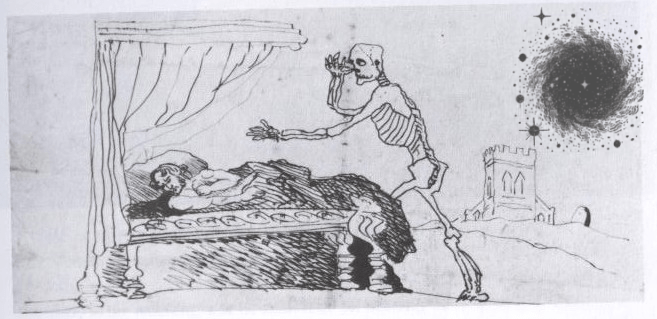
Elizabeth Gaskell’s biography of Charlotte Brontë reports an eye-witness account that Branwell, wanting to show the power of the human will, decided to die standing up, “and when the last agony began, he insisted on assuming the position just mentioned.”5 That another eye-witness account reveals he then proceeded to point upward to the sky with a look of abject fear before collapsing dead has since been stricken from the account.
The relationship between creativity and madness has been a perennial subject of enquiry in literary and psychological studies. Branwell’s case exemplifies the tension between inspiration and destruction, suggesting that his cosmic visions were both his greatest gift and his undoing. His addiction, rather than diminishing his legacy, underscores the profound and often devastating impact of grappling with existential truths.
The Brontë Conspiracy: Censorship and Erasure
The Brontë family’s suppression of Branwell’s cosmic works can be interpreted as both an act of preservation and erasure. The family’s concern for their reputation is evident in Charlotte’s preface to Wuthering Heights (1850), where she dismisses Branwell as a cautionary tale of unfulfilled potential. Yet diary entries from Emily Brontë hint at a more complex relationship with Branwell’s work. In a rarely cited passage, Emily writes, “The truths he has seen are not fit for mortal minds. They would shatter all belief, all faith.”6
Such statements reveal a dual recognition of Branwell’s vision and the dangers it posed. The suppression of his works not only reflects Victorian anxieties about propriety but also a deeper fear of confronting the void—the existential terror that lies at the heart of cosmic horror. By erasing Branwell’s contributions, the Brontë family sought to protect themselves from the unsettling implications of his visions.
Branwell Brontë and the Origins of Cosmicism
While H.P. Lovecraft is often credited with the genesis of cosmic horror, the thematic parallels between his work and the lost creations of Branwell Brontë are too striking to dismiss. Lovecraft’s notions of forbidden knowledge, humanity’s insignificance, and incomprehensible alien entities echo the philosophical concerns found in Branwell’s writings and paintings.
It is plausible, though unverifiable, that fragments of Branwell’s suppressed works influenced Lovecraft, either through oral tradition or unpublished manuscripts. Indeed, Lovecraft’s essay Supernatural Horror in Literature (1927) briefly mentions an anonymous “Yorkshire poet and painter of the 1830s whose visions anticipated those of Poe and Dunsany.”7 While speculative, this connection invites further investigation into the transmission of ideas and the hidden influences that shape literary traditions.
Branwell’s cosmicism, with its emphasis on the ineffable and the sublime, represents a crucial but neglected strand in the history of the genre. By situating Branwell within this lineage, we challenge the conventional narrative of cosmic horror’s development and acknowledge the diversity of its origins.
Restoring Branwell’s Legacy
The obscuration of Branwell Brontë’s contributions to literature and art is a profound loss to cultural history. While the nature of this essay necessitates caution, the evidence presented suggests that Branwell’s cosmic visions prefigured and perhaps inspired the works of later luminaries in the genre.
The Brontë family’s suppression of his work reflects a Victorian anxiety about confronting the void—the existential terror that lies at the heart of cosmic horror. In reclaiming Branwell as the progenitor of the genre, we not only begin to restore his legacy but also expand our understanding of the Brontë family’s creative dynamics and the origins of modern horror. The time has come to re-evaluate Branwell Brontë’s place in literary history and to acknowledge the full scope of his visions.
[1] The Cryptic Annals of West Yorkshire Freemasonry (1842).
[2] Leyland Papers, ed. Wetherington, 1902, p. 113.
[3] Letters of Charlotte Brontë, ed. Gravesmoor, 1889, p. 231.
[4] Haworth Apothecary’s Ledger (1839–1848).
[5] Gaskell, Elizabeth Cleghorn (1870). The Life of Charlotte Brontë. Smith, Elder & Company. p. 277.
[6] Emily Brontë: A Private Journal, ed. Harlingford, 1912, p. 67.
[7] Lovecraft, H.P., Supernatural Horror in Literature (1927).
 Sokal Nouveau