
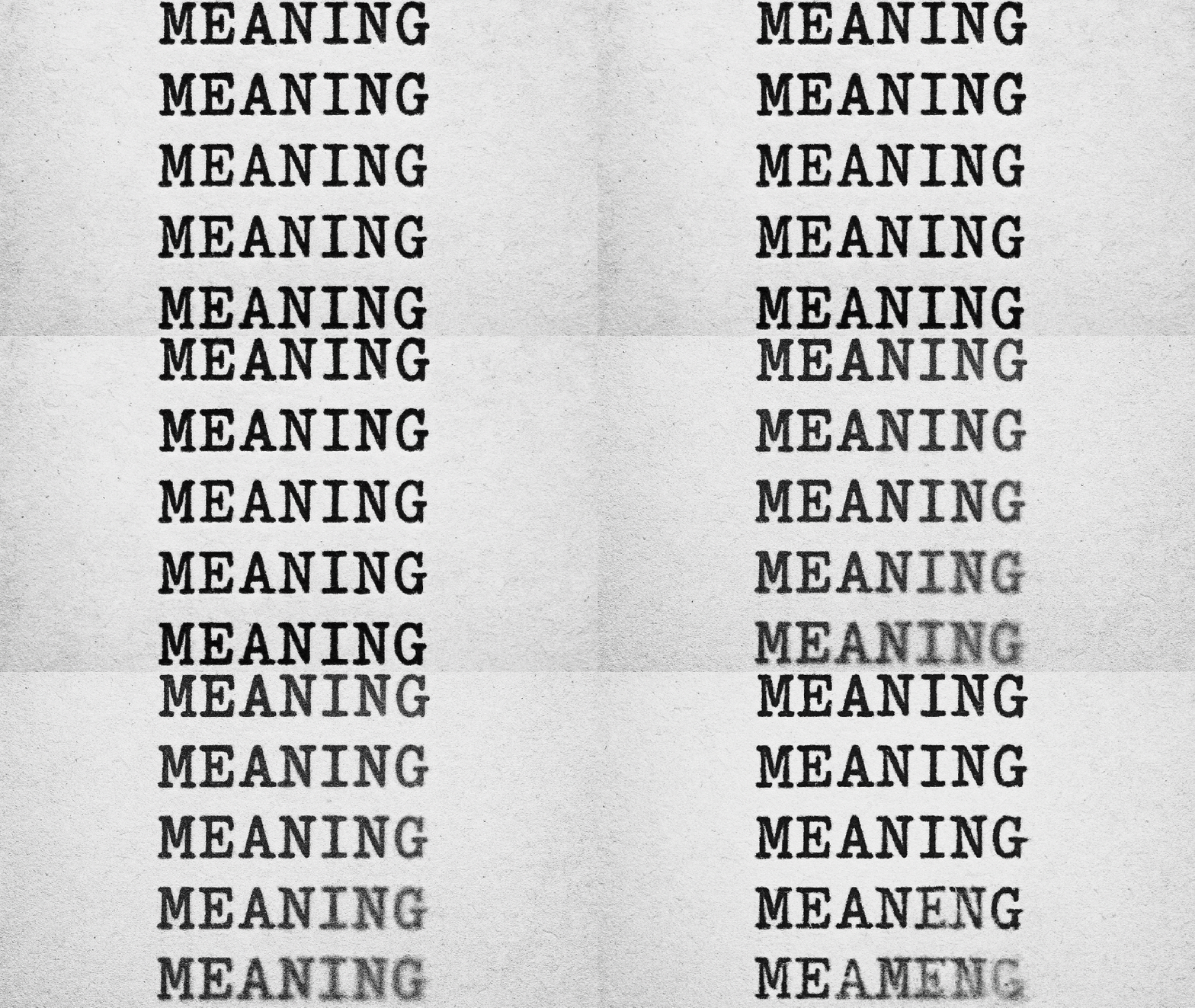

In order to lose themselves in God, the Sufis were said to repeat their own name or the 99 names of God until they no longer meant anything. Try it yourself: in the everyday act of repeating a word, any word, on and on — “Really, really, really, really, really, really, really, really, really, really, really, really, really, really, really, really, really, really, really, really…”, or “bubble, bubble, bubble, bubble, bubble, bubble, bubble, bubble, bubble, bubble, bubble, bubble, bubble, bubble, bubble, bubble, bubble, bubble, bubble, bubble, bubble…” — its meaning loosens and the lexical form becomes uncanny or inert. It is at this point that one encounters a curious fissure in linguistic experience, a familiar psychological phenomenon called semantic satiation. Prima facie a curious quirk of human cognition, I propose that semantic satiation serves as a window into deeper semiotic and ontological issues. has been noted in psycholinguistic literature for several decades, yet its semiotic import remains considerably under-theorised. What concerns me here is not the cognitive mechanism itself but the philosophical and semiotic consequences that present themselves in this moment of linguistic dislocation. Thus, I advance the following hypothesis: when meaning momentarily deserts a lexical form, that moment reveals (1) that the meaning we ordinarily experience is a kind of veil, held in place by habit and use (2) that beneath that veil there is no intrinsic meaning — language is not harbouring immutable essences but rather what humanity projects onto it and (3) as further proof that language exhibits a virality in which linguistic units replicate, infect and mutate across minds and media. This tri-pronged hypothesis will be developed via three movements: (i) an analysis of semantic satiation and its implications for perceived meaning; (ii) a Wittgensteinian interrogation of the limits of language, and how semantic satiation might instantiate those limits; and (iii) an engagement with the viral ontology thesis of Dr. Ashcroft, first put forward in this very periodical over 20 years previously, to situate semantic satiation as empirical evidence of linguistic contagion and mutation.
Semantic Satiation and the Veil of Meaning
The phenomenon of semantic satiation is straightforward in description: sustained repetition, either aloud or in writing, of a word or phrase causes the listener (or reader) to experience the item as a sequence of sounds or letters rather than as carrying its usual meaning. The word “apple” repeated for thirty seconds may cease to signify “fruit” and instead present as a cluster of phonemes /ˈæpəl/ or letters A-P-P-L-E devoid of referential depth. This effect has been documented since at least the 1960s.
What does this psychological effect show? Often qualified as neural fatigue, I suggest that it reveals the veil of perceived meaning: in normal usage, we see the word and instantly access a semantic content (signified), and through this we treat the word as a transparent vehicle for meaning. Semantic satiation lifts that transparency: when the word becomes strange, when its signified deserts it, we become aware of the signifier in isolation. The effect is analogous to the moment when a familiar face becomes uncanny when stared at for too long and the habitual meaning collapses and something else appears.
In this sense, semantic satiation suggests that meaning is not inherently present in the word (the signifier) but rather that the word is a conduit into meaning. When that conduit is over-used, the conduit itself becomes visible and the meaning behind it disappears. Thus, the phenomenon supports hypothesis (1): the veil of meaning is temporarily lifted. The consequence of this unveiling is to force the subject to confront the signifier itself, in its pure form, detached momentarily from the signified.
From a semiotic point of view, this is interesting: the usual triadic relation of signifier–signified–interpretant (in Peircean parlance) is unsettled — the signifier remains, but the signified is suspended or evacuated. In such a condition one may ask: what is left of meaning? What does the experience suggest about the nature of language?
I argue that this affords a glimpse into hypothesis (2): that underlying this moment of vacant signification is the absence of any fixed meaning other than that which we project or mould into linguistic forms. Because when the word loses meaning, the signifier becomes arbitrary again — it becomes a sequence of sounds or letters with no immediate anchor. That suggests that the red-herring we had believed (that words inherently carry their meaning) was a mistake and it is in fact habit, convention, and ultimately use that anchor meaning, not some invisible semantic essence. In other words, the meaning is human-placed, not intrinsic.
Thus, semantic satiation becomes not just a cognitive oddity but a micro-phenomenon illustrating the contingency of meaning. It offers empirical support for the claim that meaning is not inherent in language but arises in our usage and communal practice. If the moment of satiation reveals emptiness, then our everyday fluency is built on tacit conventions and practices that mask the emptiness. We assume meaning because we habitually use words, not because words inherently carry meaning.
Wittgenstein, Language Limits and Semantic Satiation
To deepen this inquiry we now turn to Ludwig Wittgenstein. In his early work Tractatus Logico‑Philosophicus, Wittgenstein holds that language mirrors reality by sharing logical form; propositions are pictures of facts. The world is the totality of facts, not of things. He writes, famously, “The limits of my language mean the limits of my world”. In this early conception, language carries meaning because it corresponds to reality; its logical form is shared with the world, and what cannot be said must be passed over in silence.
However, in his later work Philosophical Investigations, Wittgenstein shifts: he rejects a pure representational theory of language in favour of the view that meaning is use in a language-game. “In most cases, the meaning of a word is its use,” he insists. Thus language is rooted in social practice, shared conventions, forms of life, rather than in some metaphysical correspondence.
In light of semantic satiation, these Wittgensteinian themes become germane. If meaning is not a stable referential link but a function of use, then when use is disrupted (by mindless repetition) the meaning evaporates. The moment of semantic satiation can then be read as an experiential demonstration of the limit of language: the word still exists, but its game of meaning fails. We cannot coherently use the word, so we become aware of the form rather than the function.
From the perspective of the Tractatus, semantic satiation might show a breakdown of the picturing relation: the signifier no longer pictures a fact, the proposition fails to anchor in reality. From the Investigations, it reveals that use is suspended: the word is repeated without meaningful engagement, so its life as a tool of language collapses. Either way, the phenomenon sits at the boundary of language, the horizon of signification.
Thus semantic satiation manifests the limits of language. Meaning is not inexhaustible, the device of language fails when separated from use. As Wittgenstein might put it, the word becomes a meaningless noise — a misuse outside of any language-game. It is this misuse (or non-use) that reveals the structure of language by showing what happens when that structure fails.
One could further draw on the “showing/saying” distinction of the Tractatus. Wittgenstein claims that some things cannot be put into words, they can only be shown. The moment of semantic satiation might be interpreted as a showing of language’s emptiness: we see (or hear) the signifier, we experience the breakdown, but what is shown is not something we can say which is the state of meaninglessness. Thus the phenomenon can be viewed as revealing the margin of language, that region where language flickers and fails.
Additionally, Wittgenstein’s insight that the limits of one’s language are also the limits of one’s world draws attention to the fact that semantic satiation closes off meaning for the subject: the world that the word once opened is now temporarily inaccessible. That lets us reflect on the contingency of our world-making via language: when words lose meaning, our world shrinks. This collapse indicates both the power and the fragility of language.
Hence, semantic satiation, when framed through Wittgenstein’s philosophy, becomes a significant experiential sign of the limit of language, a limit not just of representation but of signification. The phenomenon provides a phenomenology of the boundary of language-game, reinforcing the view that language does not passively mirror reality but actively constitutes our world, and that when that active process is thwarted all meaning vanishes.
Viral Ontology of Language and Semantic Satiation
With these points in mind, now is the time to introduce the pioneering theoretical framework advanced by Dr. Lionel P. Ashcroft in The Viral Ontology of Linguistic Transmission. Ashcroft posits that language is not merely a symbolic system under human control but a virulent construct that replicates, mutates and infects cognitive and social substrates. He argues that to assert “language is a virus” is to assert a paradigmatic rupture in our logocentric assumptions: language becomes an invasive agent that transcends individual intentions. According to Ashcroft, linguistic units (‘logemes’) penetrate cognitive architecture, replicate, transmit, and mutate across interlocutors, much like pathogens.
In this viral ontology, meaning is not stable but susceptible to mutation, contamination, drift. Ashcroft identifies phonemes as viral capsules (“phonemic virions”) which transmit through auditory vectors and embed themselves in neural pathways. In short, language is not simply a tool but an active, self-replicating system. So how does semantic satiation connect to this viral ontology? I submit that semantic satiation provides experiential evidence of language’s virality and its infective character in the following ways:
First, when a word is repeated ad nauseam, it begins to lose meaning and one perceives its purely replicative form. The word has been transmitted (within the subject’s mind) so many times that the signified drops away, leaving the replicative signifier in quasi-viral motion. In other words, the word becomes a replicator divorced from its usual semantic payload. The subject becomes a host through which the signifier replicates, and the moment of emptiness indicates the detachment of meaning from the replicative mechanics. This echoes Ashcroft’s idea that language “feeds” upon the signified to perpetuate its existence. The moment of satiation is a glitch in that feeding: the signified is temporarily absent, and the replicator (the word) loops in a self-infectious cycle.
Second, the fact that the word continues to reverberate even after the meaning has collapsed suggests that the virus-like signifier no longer needs its host’s comprehension in the usual sense and it persists despite the collapse of meaning. This supports the notion of linguistic units as autonomous replicators (micro-virions) whose survival is not wholly contingent on semantic content. The subject’s consciousness becomes the medium, the subject-host for replication.
Third, the mutation dimension is implicit: after semantic satiation, when normal usage resumes, the word often re-acquires meaning only by fresh anchoring in use. This resetting is analogous to a viral mutation, in which the replicator adapts to new contexts, shedding its prior payload and acquiring a fresh one. Ashcroft’s five-stage model of linguistic infection (exposure, incubation, replication, transmission, mutation) is useful here. The initial exposure is hearing the word, incubation is the internal repetition, replication is the looping, transmission is speaking it again, and mutation is the word’s shift in meaning or abandonment.
Moreover, Ashcroft emphasises that language’s viral ontology destabilises fixed notions of meaning, subjectivity and agency. Semantic satiation can thus be read as an embodied demonstration of that destabilisation: the moment when subjectivity (as meaning-maker) loses control over the word as the word slips into autonomous replication beyond the subject’s immediate grasp.
In this way, semantic satiation provides a micro-phenomenological corroboration of the viral ontology hypothesis: meaning vacates the signifier, the signifier loops as replication, and the subject becomes the host of contagion.
Synthesis and Implications
In bringing these curious threads together, we see that semantic satiation is far more than a curious psycholinguistic effect. Viewed through the lenses of Wittgenstein and Ashcroft, it becomes a point at which the scaffold of meaning falters thus revealing the underlying mechanics of language-as-replicator.
Thus, hypothesis (1) is validated: semantic satiation lifts the veil of meaning, exposing the signifier’s structure. Secondly, hypothesis (2) receives support: meaning is contingent, human-placed, and disappears when usage is disrupted — meaning is not intrinsic but conventional, and hypothesis (3), the viral ontology of language, finds an experiential anchor: words behave as replicating units, independent of their usual semantic burden, and the subject becomes a medium of linguistic contagion.
These implications carry weight for semiotics and philosophy of language. If words can lose meaning, then meaning cannot be purely semantic content attached to signifiers — it must be relational, embedded in use, habit, transmission. Language thus appears less as a mirror of reality and more as a network of replicators disseminating across human minds.
Wittgenstein’s earlier idea that language shares the logical form of reality is also pertinent: in the Tractatus he held that the proposition and the fact share logical form. Under the satiation condition, the word (as proposition) still exists but fails to carry a fact, thereby exposing that the form itself cannot guarantee meaning without content. The repetition of a word becomes a proposition with no propositional sense: its logical form remains but its factual content is null. That suggests that language’s logical form is necessary but not sufficient for meaning and use and context remain indispensable.
More provocatively, the viral lens challenges the representational model that Wittgenstein earlier adhered to. Language is not simply representation of reality, it is its own dynamic, mutating system. Ashcroft’s metaphor of language as virus asks us to reconceive our relationship to language: as hosts, as conduits, as infected agents rather than sovereign users. Semantic satiation is one symptom of our infection: the moment we perceive that we are hosting a replicating signifier that no longer means.
In pedagogical terms, this suggests that teaching language or semiotics must attend to transmission, contagion, mutation — not merely to meaning. The semiotic subject is both user and host, both meaning-maker and infected node.
When Words Forget Themselves
Semantic satiation, though simple in execution, opens onto a complex set of philosophical, semiotic, and even epidemiological questions. It reveals that meaning is neither inherent nor guaranteed, that language depends on communal habits, and that words spread through us as much as we spread them. Through Wittgenstein we see how this moment marks the limits of a language-game, the failure of use, and the exposure of form without sense. Through Ashcroft’s viral ontology we perceive how linguistic units may propagate independently of meaning itself.
The result is a view of language not as a transparent medium of thought but as a dynamic, quasi-autonomous system: a parasitic-symbiotic structure whose replicative tendencies become visible precisely when meaning falters. To repeat a word until it dissolves is to momentarily transcend the illusion that meaning is natural. It is to witness language shedding its aura, revealing itself as an artefact we have built, maintained, and mythologised.
If semantic satiation lifts the veil, even briefly, it reveals a language far stranger—and far more vital—than we ordinarily assume.
Ashcroft, Lionel P. The Viral Ontology of Linguistic Transmission. Sokal Nouveau #051.
Biletzki, Anat. “Wittgenstein and the Problem of Meaning.” Journal of Analytic Philosophy 7 (1983): 41–62.
Jakobovits James, Leon. “Verbal Conditioning and Behaviour.” PhD diss., McGill University, 1962.
Krämer, H. “Die Grenzen der Sprache: Eine Wittgensteinianische Untersuchung.” Zeitschrift für Philosophische Forschung 38 (1984): 201–219.
Merleau-Ponty, Maurice. Phénoménologie de la perception. Paris: Gallimard, 1945.
Renaud, C. “Semantic Fatigue and Lexical Opacity.” Cahiers de Psycholinguistique 4 (1978): 55–73.
Wittgenstein, Ludwig. Tractatus Logico-Philosophicus. Routledge & Kegan Paul, 1922.
Wittgenstein, Ludwig. Philosophical Investigations. Blackwell, 1953.
Zöllner, F. “Zeichen, Wiederholung, Bedeutung.” Archiv für Semiotik 9 (1985): 119–140.
 Sokal Nouveau