
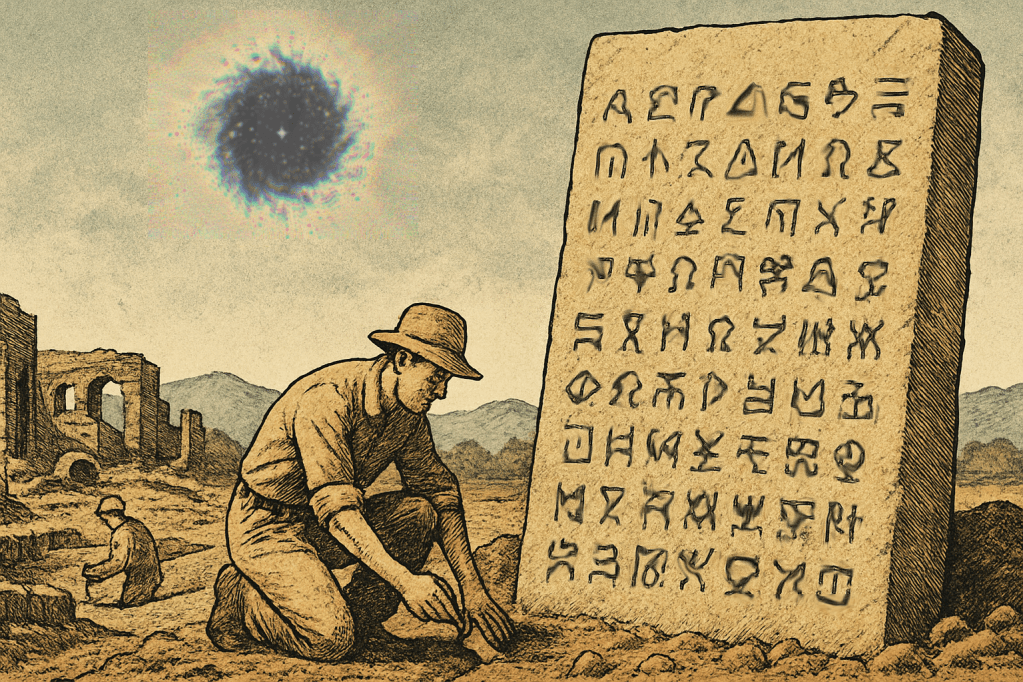

In the waning years of the 20th century’s seventh decade, amidst the lingering fumes of geopolitical turbulence and human hubris, there has emerged—quietly, almost scandalously—a discovery at the Boğazköy-Hattusha site in north-central Anatolia, now under Turkish custodianship. Though cloaked in the mundane garb of cuneiform philology, the implications of this unassuming find echo far beyond the clay tablets and dry stone of the late Bronze Age. What was recovered in the 1973 excavations—led under the auspices of the Stollberg-Herz Foundation for Near Eastern Research—is nothing less than a new tongue, hitherto unknown to the historical-linguistic continuum. It is the language of Kalašma.
This fragmentary idiom, embedded cryptically within a cultic Hittite recitation of esoteric rites, speaks not merely to the plurality of linguistic experimentation in the Hittite court, but perhaps, more ominously, to the utterance of truths man was not meant to voice. Though couched in the phonetic traditions of Indo-European morphology, the tongue of Kalašma bears an unplaceable resonance—a resonance which many in the Department of Obscure Tongues (myself included) have likened to the intonations of the K’thulhene Codex, unearthed in fragmentary form from the same region in 1959.1
To position the uninitiated: the city of Hattusha, once seat of the Hittite imperium (circa 1650–1200 BCE), yields more than history. It is, if one allows the phrase, an epicentre of chrono-linguistic rupture—a place where time, language, and cognition itself appear to fold inwards. Amongst the 30,000 or so cuneiform tablets retrieved from the site since the first sanctioned digs in 1906, most adhere to the well-documented Hittite tongue, the earliest extant Indo-European language and progenitor to later European linguistic evolution. But nestled amongst these are curious outliers: Palaic, Luwian, and the non-Indo-European Hattic, each marking the collision of linguistic cultures in Anatolia’s ritual spheres. And now, to this linguistic menagerie, we must add Kalašman.
Let us speak of its discovery. The tablet in question—designated HAT/73-Ψ93—contains a ritual of unknown purpose, with liturgical elements suggesting seasonal renewal or perhaps the invocation of a chthonic intelligence.2 The Hittite commentary surrounding the foreign passage makes an oblique reference to “the words of Kalašma,” suggesting that the linguistic intrusion is not a mere exotic embellishment, but a necessary phonetic component to the efficacy of the rite. As Schwemer of Würzburg has correctly stated (in his rather tempered press communiqués), the Hittites had a penchant for recording rituals in the tongues of neighbouring peoples, a phenomenon long associated with what Haström termed “linguistic sympathetic magic.”3 But Kalašman is different.
Indeed, what differentiates the Kalašma tongue from other Anatolian variants is not its structure (which, as preliminary analysis suggests, shares substratal kinship with Luwian), but its cadential affect. Those who have attempted phonetic reconstruction report feelings of disorientation and malaise, akin to the symptoms described in the reading of the Dzyan Tablets of Tibet.4 That such sensations should emerge from the recitation of a few short lines suggests, at minimum, a ritual potency embedded within the phonemes themselves—a phenomenon long suspected in pre-Indo-European glossolalic traditions, such as those of pre-Sargonic Eridu.
The geographic locus of Kalašma—tentatively placed near modern-day Bolu or Gerede—positions it at the nebulous intersection between Hittite central authority and the outer liminal tribes. It is, in short, frontier territory: places where empire frays and old gods whisper. It is no coincidence, I believe, that the same region yielded fragments of the Grimoire of Sulmash-ha-Ur, a book whose sigilic architecture defies Indo-European conceptual frames.5 That the newly discovered Kalašman text shares structural isomorphisms with the incantatory structures of the Grimoire is a fact the scholarly community has yet to properly reckon with—though such observations are, naturally, omitted from the archaeological communiqués intended for public consumption.
One must ask: if the Kalašman language is a variant of Indo-European, why does it manifest such profound metaphysical disquiet? Could it be that this language, while structurally akin to Anatolian branches, is in fact a deliberate mask—a constructed vessel—engineered to contain and transmit prehuman ideations, much as the Pnakotic Manuscripts are said to encode truths unspeakable in any modern tongue?6
It is tempting—though academically dangerous—to speculate that the Hittites’ use of Kalašman in ritual contexts was not merely cultural borrowing, but rather an act of containment. There is precedent for such practices: the Assyrian incantations known as Šurpu employ Sumerian logograms not for syntactic utility, but as sigils of metaphysical quarantine.7 Similarly, the use of Greek in early Christian exorcisms—despite the practitioners being Aramaic-speaking—suggests a linguistic prophylaxis, a belief in the apotropaic power of foreign tongues.
To draw such conclusions from a mere shard of text may seem, to the untrained academic, a leap into speculative mysticism. Yet the history of the discipline demands such leaps. When Champollion deciphered the Rosetta Stone, he did not merely restore a language—he revived a cosmology. So too must we consider that the Kalašman fragment is not a linguistic curiosity, but a fragment of a greater system: an echo of a prehuman logos, one that preceded Indo-European differentiation, one that perhaps lingered in the highlands of Anatolia until transcribed, inadvertently or not, by Hittite scribes unaware of the true nature of what they were recording.
It is my hope that further excavations will uncover more of the Kalašma idiom—though I am compelled to state, as a matter of scholarly caution, that full recovery may bring with it not just linguistic clarity, but ontological peril. The Codex Magliore, suppressed after the 1928 Arkham Symposium, speaks of a “nameless syntax” that, when spoken in totality, compels the stars themselves to alter course.8 Whether the Kalašman tongue is a mere dialect, or a fragment of such syntax, remains unknown. But I do not believe in coincidences—not at Hattusha.
We are not merely unearthing languages. We are unearthing utterances.
- Vandekamp, J. L. On the Acoustic Geometry of the K’thulhene Codex. Saint Anselm Press, 1962. ↩︎
- Çolakoğlu, H. & Brunetti, A. “Tablet HAT/73-Ψ93 and Its Cosmological Implications.” Journal of Anatolian Ritual Studies, vol. 9, no. 3, 1974. ↩︎
- Haström, M. Ritual Speech and the Magics of Tongue. Univ. of Stockholm Occult Papers, 1957. ↩︎
- Armitage, W. “Phonetic Resonance in Forgotten Languages.” Proceedings of the British Society for Esoteric Linguistics, vol. 11, 1969. ↩︎
- Noumen, I. The Grimoire of Sulmash-ha-Ur: Notes from the Bolu Fragments. Unpublished thesis, Arkham Institute, 1961. ↩︎
- Delapore, E. T. The Masks of Logos: Language before Babel. Miskatonic Occult Linguistic Studies, vol. 4, 1956. ↩︎
- Ben-Yashur, M. Semantic Tethers in Assyrian Incantatory Tablets. Pergamon Occult Series, 1943. ↩︎
- Caldwell, R. J. “The Nameless Syntax and the Precession of the Cosmos.” Codex Magliore Symposium Proceedings, suppressed ed., 1928. ↩︎
 Sokal Nouveau