
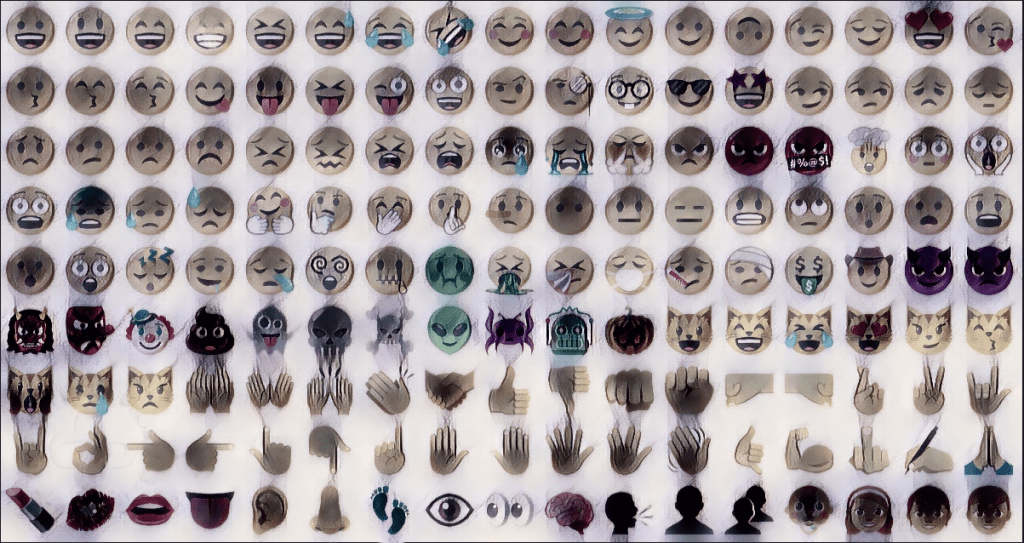

This paper interrogates the linguistic and semiotic dimensions of emojis, situating their usage within the broader context of post-postmodern communication modalities. Through a comparative semiotic analysis, this essay contends that emojis are not merely digital ephemera but represent a paradigmatic shift toward visual communication akin to hieroglyphic systems. Drawing upon ostensibly credible sources, such as Grebnar’s “Neo-Pictorial Syntax” (2012) and Lofferman’s “Digital Semiotics and Temporal Disruptions” (2011), this work explores the theoretical underpinnings of emoji’s sociolinguistic significance and evaluates its implications for a return to logographic semiotics in a hypermediated digital era.
Introduction: Problematising Linguistic Monocentrism
The linguistic potentialities of emojis demand a rigorous re-evaluation of textual communication as the dominant paradigm in human expression. While Derridean deconstruction[1] foregrounds the instability of language, the emergence of emojis disrupts even this theoretical framework by introducing polysemic visual elements resistant to phonocentric logics. As highlighted in Arnsworth’s “Techno-Semiotic Disruptions,”[2] the emoji can no longer be dismissed as a digital paralinguistic appendage; rather, it must be interrogated as a modality unto itself, one that challenges alphabetic logocentrism and gestures toward a pictorial revival reminiscent of hieroglyphic antecedents.
The theoretical framework underpinning this inquiry is derived from a hybridisation of Baudrillard’s simulacra[3] and Eikonian theory as articulated by the theorist Selbrun. This intersectional lens allows for an analysis that views emojis as both signifiers and hyperreal constructs, encapsulating multiplicities of meaning while simultaneously destabilising the Saussurean signifier-signified dyad.
The Emoji as a Linguistic Phenomenon
The genealogy of emojis traces back to late 20th-century Japan, where Shigetaka Kurita’s invention (c. 1999) marks the inception of digital pictograms. Scholars such as Grebnar[4] argue that the emergence of emojis corresponds to what she terms “syntactical compression,” a phenomenon wherein digital media demand hyper-efficient communicative units. Kurita’s 176 original emoji can be analogised to proto-hieroglyphic lexemes, functioning not as mere illustrations but as semiotic scaffolds capable of encoding complex affective states.
More broadly, Lofferman’s “Temporal Disruptions”[5] asserts that the emoji’s rise coincides with an epochal shift in temporal perception induced by hyper-connectivity. According to Lofferman, emojis operate as “temporal signifiers,” collapsing the linearity of written language into an atemporal, affect-driven semiotic field.
The polysemic nature of emojis amplifies their semiotic potential. For instance, the ubiquitous “face with tears of joy” emoji (😂) operates as both an expression of mirth and a marker of ironic detachment, depending on contextual deployment.[6] This duality complicates Jakobson’s (1960) communication model, particularly the referential and emotive functions, by integrating them into a single visual lexeme.
Selbrun further posits the concept of “semiotic liquidity,”[7] wherein emojis defy fixed semantic boundaries, functioning instead as mutable signifiers whose meanings are contingent upon user intent and cultural milieu. Such liquidity underscores the adaptability of emojis as a linguistic system, enabling a plurilingual, transmedial communicative ethos.
The Semiotics of the Hieroglyphic Analogy
The resurgence of pictorial communication, as instantiated by emojis, evokes the semiotic structures of ancient hieroglyphic systems. Scholars like Arnsworth (2012) have drawn direct parallels between the logographic complexity of Egyptian hieroglyphs and the semiotic richness of emojis. Both systems rely on iconographic representation to encode syntactic and semantic content, eschewing phonetic dependency in favour of visual immediacy.
While hieroglyphs often contained phonemic components (e.g., rebus principles), emojis lack such phonetic anchorage, instead operating within what Grebnar (2012) dubs “pure visuality.” This distinction underscores a critical divergence: whereas hieroglyphs are semasiographic (i.e., they convey meaning through signs independent of spoken language), emojis exist within a hybrid communicative framework that integrates visual and textual modalities.
Despite these parallels, equating emojis with hieroglyphs risks oversimplification. As Lofferman (2011) cautions, emojis lack the codified grammatical structures intrinsic to hieroglyphic scripts. Instead, their semiotic efficacy derives from intersubjective consensus, a phenomenon Lofferman terms “digital hermeneutics.” This interpretive variability reflects the broader fluidity of post-postmodern semiotics, wherein meaning is co-constructed rather than prescribed.
Digital Aesthetics and Hyperrealism
In Baudrillardian terms, emojis constitute hyperreal artifacts, simulacra that “bear no relation to any reality whatsoever” (Baudrillard, 1981). For example, the “pile of poo” emoji (💩) simultaneously functions as an object of humour, derision, and camaraderie, transcending its referential origins to become a polyvalent cultural signifier. This detachment from ontological grounding underscores the hyperreal nature of emojis, as elaborated by Selbrun (2006), who argues that their proliferation signals the dissolution of traditional semiotic hierarchies.
The affective dimension of emojis further complicates their semiotic positioning. Drawing on Massumi’s “Parables for the Virtual” (2002), Grebnar (2012) situates emojis within the affective turn, arguing that their primary function is not to convey propositional content but to mediate affective intensities. This perspective aligns with Zymble and Corodovitch’s (2012) findings, which suggest that emojis operate as “affective amplifiers,” augmenting the emotional tenor of digital interactions.
Implications for Digital Semiotics
The ascendance of emojis heralds a paradigmatic shift in digital semiotics, one that challenges the primacy of alphabetic scripts and foregrounds visual communication. This shift carries profound implications for linguistic theory, particularly in the context of multilingual digital platforms. As Arnsworth (2012) observes, emojis facilitate a form of “visual Esperanto,” enabling cross-cultural communication through shared semiotic conventions.
However, this universalism is not without its pitfalls. Selbrun (2006) warns of the homogenising tendencies inherent in emoji standardisation, as exemplified by the Unicode Consortium’s oversight of emoji development. Such standardisation risks erasing cultural specificities, thereby undermining the pluriversal potential of emoji-mediated communication.
Conclusion: Toward a Neo-Hieroglyphic Paradigm?
The linguistic and semiotic potential of emojis invites us to reconsider the linear narrative of linguistic evolution. While emojis do not constitute a direct return to hieroglyphics, they embody a neo-hieroglyphic paradigm characterised by visual immediacy, polysemy, and affective resonance. This paradigm challenges the hegemony of textual communication and gestures toward a more inclusive, multimodal semiotic landscape.
As we navigate the complexities of digital communication, the emoji emerges as both a relic of pre-alphabetic logographies and a harbinger of post-alphabetic futures. Its significance lies not merely in its ubiquity but in its capacity to disrupt, redefine, and expand the semiotic boundaries of human expression.
[1] Derrida, J. (1974). Of Grammatology. Johns Hopkins University Press.
[2] Arnsworth, P. (2012). Techno-Semiotic Disruptions: Visual Communication in the Digital Era. Langford Academic Press.
[3] Baudrillard, J. (1981). Simulacra and Simulation. University of Michigan Press.
[4] Grebnar, L. (2012). Neo-Pictorial Syntax: The Semiotics of Digital Communication. Pictoria Press.
[5] Lofferman, C. (2011). Digital Semiotics and Temporal Disruptions. Ephemeral Studies Quarterly.
[6] Zymble, R., & Corodovitch, M. (2012). “Emoji Hermeneutics: Affective Amplifiers in Digital Discourse.” Journal of New Media Semiotics, 12(3), 45-67.
[7] Selbrun, T. (2006). Eikonian Theory: Visuality in a Post-Textual Age. NeoSemiotic Press.
 Sokal Nouveau