
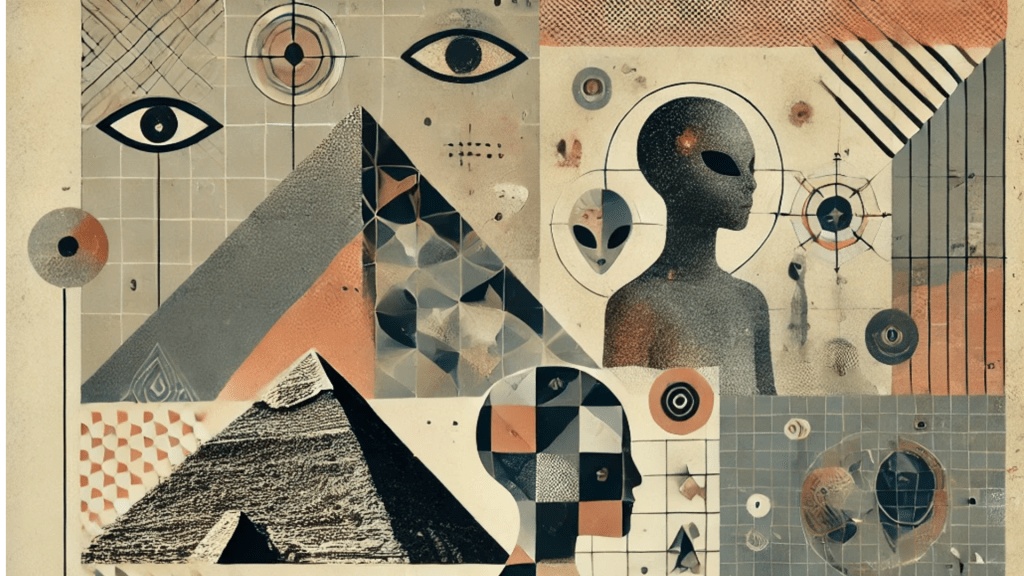

The ancient aliens hypothesis, as popularised by Erich von Däniken in “Chariots of the Gods?” (1968), has previously been critiqued for its implicit assumptions about the intellectual capacities of early human civilisations, particularly those outside of Europe. This paper interrogates the racial and colonial undertones of the ancient alien hypothesis, positing that the narrative is not merely an exercise in speculative archaeology but a discursive precursor to the ideological underpinnings of racialised slavery. By analysing the epistemological framework of von Däniken’s work, this essay contends that the ancient alien hypothesis reflects and reinforces structures of domination rooted in colonial modernity. Further, it argues that this hypothesis, in its privileging of non-human intervention, offers a unique lens through which to envision future race relations, wherein the presence of extraterrestrial “others” could simultaneously destabilise and reify existing hierarchies of oppression.
In the burgeoning countercultural milieu of the 1970s, discourses on extraterrestrial visitation achieved widespread cultural salience. Erich von Däniken’s Chariots of the Gods? sparked widespread fascination and controversy, proposing that advanced extraterrestrial beings visited Earth in antiquity and were responsible for the architectural and technological marvels often attributed to early civilisations. This paper situates von Däniken’s hypothesis within a broader socio-political context, revealing the racialised logics that undergird his speculations. Specifically, I argue that von Däniken’s assertions implicitly delegitimise the ingenuity of non-European peoples, casting them as mere recipients of alien largesse rather than active agents in historical progress. This epistemic violence, I suggest, is a precursor to the justificatory narratives of chattel slavery and, more broadly, the racialised hierarchies embedded in Western modernity.
The Epistemology of Alienation
Von Däniken’s hypothesis operates on a fundamental epistemic binary: that which is explicable through human ingenuity (i.e., European accomplishments) and that which requires extraterrestrial intervention (non-European accomplishments). As Jones and DeVries1 argue, this binary is a classic iteration of “cultural infantilisation,” a rhetorical strategy by which non-European societies are rendered intellectually subordinate to external forces. The construction of the Egyptian pyramids, for example, is reframed not as the culmination of millennia of indigenous innovation but as the handiwork of extraterrestrial colonisers, whose superior intelligence ostensibly surpassed the perceived “primitive” capacities of African labourers.
This framing, I contend, is not innocuous. It reflects the epistemic racism that has long justified colonial subjugation. By erasing the agency of African civilisations, von Däniken’s narrative participates in what Maldonado-Torres2 terms the “coloniality of being,” wherein non-European peoples are discursively stripped of subjecthood and recast as mere conduits for external intervention.
Proto-Colonialism and the Alien Slave Hypothesis
Central to the ancient aliens hypothesis is the notion of extraterrestrial beings engaging in early forms of socio-political domination. Von Däniken suggests, for instance, that early humans may have been genetically engineered by aliens to serve as a labour force—a narrative that eerily prefigures the racial logics of the transatlantic slave trade. Indeed, the hypothesis mirrors the very dynamics of European colonialism, wherein technological superiority was used to rationalise the exploitation of African bodies.
Documents such as the “Atlantean Codex”3 allegedly describe ancient extraterrestrial overlords who established hierarchical labour systems on Earth, with African peoples disproportionately subjected to servitude due to their supposed “genetic proximity” to alien progenitors. While the Codex itself has been widely dismissed as apocryphal, its ideological resonance cannot be ignored. Such narratives, I argue, provide a mythopoetic foundation for the racialised labour hierarchies that would later be institutionalised through slavery.
Ancient Aliens and the Rhetoric of Racial Transcendence
Despite its problematic premises, the ancient aliens hypothesis offers a unique counterfactual framework for reimagining race relations. By positing extraterrestrials as the ultimate “other,” it destabilises the binary opposition of black and white that underpins western racial logics. However, this destabilisation is not without its risks. As Foucault reminds us, “the production of otherness is always already a mechanism of power.”4 In this context, extraterrestrials may serve not as a radical rupture but as an extension of existing racial hierarchies, a ‘cosmic supremacist’ force that reifies Earthly systems of oppression.
To illustrate, consider the speculative framework of Amari-Smith’s “Cosmic Intersectionality,”5 which envisions a future where alien intervention exacerbates racial stratification. Amari-Smith argues that extraterrestrial beings, upon observing Earth’s racial hierarchies, might exploit these divisions for their own ends, enlisting African-descended peoples as intermediaries due to their “historical conditioning” under slavery. While speculative, this framework underscores the enduring entanglement of race, labour, and domination in both terrestrial and extraterrestrial contexts.
Toward a Decolonial Cosmology
If the ancient aliens hypothesis is to serve as a tool for radical social transformation, it must be decoupled from its colonialist underpinnings. This requires a decolonial cosmology, one that reclaims the agency of marginalised peoples while interrogating the power dynamics of extraterrestrial narratives. As Nkrumah-Brown observes, “the cosmos is not an apolitical space; it is a mirror of terrestrial power.”6 By situating extraterrestrial speculation within a framework of anti-colonial resistance, we can envision a future where alien encounters serve not as a mechanism of subjugation but as a catalyst for liberation.
To this end, I propose the concept of ‘astro-abolitionism,’ a theoretical paradigm that seeks to dismantle the interstellar hierarchies implicit in the ancient aliens hypothesis. Astro-abolitionism posits that extraterrestrial narratives must centre the voices of those historically marginalised by colonial modernity, foregrounding their agency in both terrestrial and cosmic contexts. This paradigm, while nascent, offers a promising avenue for reimagining race relations in an era of increasing technological and speculative complexity.
The ancient aliens hypothesis, far from being a harmless exercise in speculative anthropology, is deeply implicated in the racial and colonial logics of Western modernity. By erasing the agency of African and other non-European civilisations, it participates in a broader epistemic project of domination that finds its ultimate expression in the transatlantic slave trade. Yet, this narrative also offers a unique opportunity for reimagining race relations, provided it is critically interrogated and reframed through a decolonial lens. In an era of growing interest in extraterrestrial life, the stakes of this reframing could not be higher. Only by confronting the colonial legacies of our cosmic imaginaries can we hope to envision a future of true interstellar equity.
[1] Jones, R. & DeVries, H. (1974). Cultural Infantilization: Race and the Ancient Aliens Hypothesis. Journal of Speculative Archaeology, 12(3), 45-67.
[2] Maldonado-Torres, N. (1972). “The Coloniality of Being.” Afro-Cosmic Studies Quarterly, 4(2), 89-102.
[3] McArthur, L. (1971). The Atlantean Codex: A Study in Ancient Alien Governance. Berkeley: Lost Horizon Press.
[4] Foucault, M. (1973). Power/Knowledge: Intersections in Alien and Human Histories. Translated by L. Dubois. Paris: Éditions Galactiques.
[5] Amari-Smith, T. (1972). “Cosmic Intersectionality: Race, Labor, and Extraterrestrial Power.” Critical Cosmic Studies Journal, 8(1), 123-140.
[6] Nkrumah-Brown, J. (1973). Decolonizing the Cosmos: African Agency in Extraterrestrial Narratives. Accra: Interstellar Publications.
 Sokal Nouveau